How Agentic AI Is Reshaping Healthcare’s Ransomware Recovery Strategy

Healthcare is moving fast. Agentic AI—software that thinks and acts on its own—is now inside hospitals. Clinicians use it. Operations depend on it.
So do attackers.
Ransomware has always targeted healthcare. Sensitive data, time pressure, and aging infrastructure make it an attractive target. As AI becomes embedded in daily workflows, the attack surface grows. Recovery gets harder.
By the time many attacks are discovered, backups are already compromised. Restoring from a corrupted backup does not fix the problem. It restarts it.
CyberSense by Index Engines validates database integrity in both production storage and backup environments, providing organizations with the earliest possible warning. When an attack occurs, we identify exactly what happened and where clean data exists. That work sits inside a larger frame: Return on Risk. Every dollar invested in resilience should reduce real, measurable exposure. This blog explains how.
Most healthcare AI offers suggestions. A clinician reads it, then decides. Agentic AI acts.
It sets a goal, gathers information, takes steps, and adjusts at each stage without waiting for human input. A clinical documentation agent retrieves patient context, drafts a note, checks for errors, and updates the record. The physician never touches a keyboard.
That autonomy is powerful, and it introduces new risk. A system that reads, writes, and acts across your data environment can also be turned against you.
The drivers are real and urgent.
Agentic AI reduces documentation burden, accelerates diagnosis, and improves care coordination. Documentation fatigue is a leading cause of physician burnout. AI agents are already handling prior authorizations, staffing, and supply chain management with measurable financial results.
New policies are pushing in the same direction. Health systems building AI capabilities now are gaining ground. Those who wait are losing it.
Current use cases: Clinical documentation, radiology support, prior authorization, patient triage, revenue cycle management, supply chain optimization, and EHR summarization.
Healthcare AI connects to EHR platforms, imaging systems, lab systems, medical devices, and cloud infrastructure. All of it depends on one thing: complete, accurate, uncompromised database content.
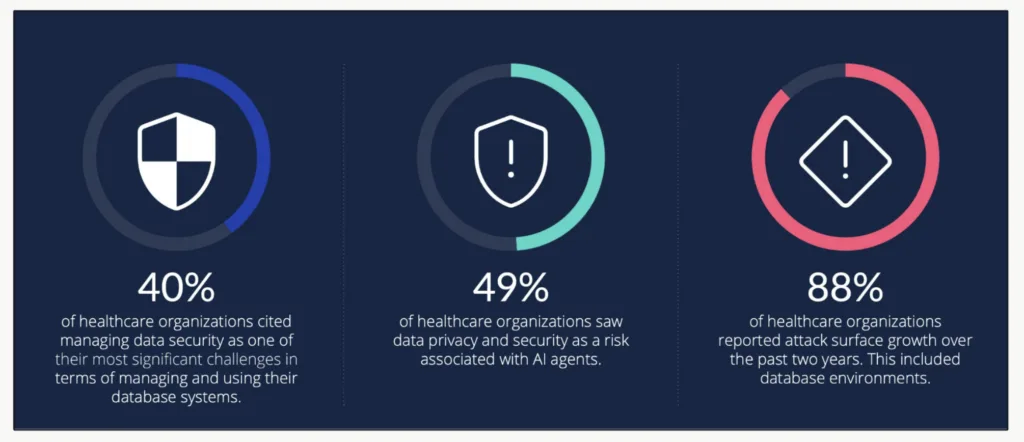
That dependency is what makes a successful attack so damaging. When the databases powering AI workflows are corrupted, the damage radiates across the entire environment. Eighty-eight percent of healthcare organizations reported growth in their attack surface over the past two years. Database environments were explicitly included.
Patient data commands high prices on criminal markets. Downtime creates life-safety pressure to pay quickly. Legacy systems, such as unpatched EHRs or aging medical devices, offer easy entry points. Connected clinical and administrative networks make lateral movement simple.
The financial damage is severe. Multi-week outages, tens of millions in remediation costs, patient diversions, and regulatory fines are now common. The human cost, such as delayed procedures and deferred care, is harder to measure but well-documented.
Attackers used to move slowly, giving defenders a window to catch them. That window is closing.
Dwell time fell from 36 days in 2023 to 22 days in 2025. Many attacks move faster. CrowdStrike recorded an average breakout time of just 48 minutes. The fastest confirmed attack in 2025 went from compromise to full encryption in three hours.
The speed is deliberate. Faster attacks reduce the chance of detection before the payload fires. Backup systems are a primary target because corrupting or destroying them eliminates the recovery option. A shorter dwell period makes this worse. There is less time to detect the intrusion before backup data is affected.
Restoring from a backup created during that window recovers a compromised environment.
AI makes this problem larger. Attackers are shifting away from straightforward encryption toward database-layer attacks: content corruption, partial encryption, and index-level manipulation. These means systems appear intact while the data underneath is damaged. They are far harder to detect, and far more dangerous when AI agents rely on that data to support clinical decisions.
Prompt injection lets attackers redirect an AI agent’s behavior without touching underlying systems. A compromised agent with broad access to clinical and administrative databases becomes a powerful exfiltration tool at scale.
The core problem: AI amplifies whatever it ingests. Corrupted databases fuel it with bad information. Errors surface faster and scale further than they ever could through manual processes.
 Having a backup is not the same as having a trustworthy one.
Modern ransomware targets backup systems early. Some malware lies dormant in backup files for days, activating only after restoration. Restoring from this data does not achieve recovery. It achieves reinfection.
The problem starts in production. Ransomware corrupts live databases before any backup is taken, often days earlier. An organization monitoring only backup health is watching the wrong place.
The stakes are higher when AI is involved. Traditional tools inspect metadata, file system patterns, or high-level anomalies. They do not analyze the deep internal structures of healthcare databases or identify the nuanced corruption that AI agents might treat as valid information.
The result is predictable. Incorrect data feeds AI agents false clinical insights. Index manipulation leads to incorrect patient record retrieval. Partial encryption can lead to unnoticed failures in workflow automation. And restoring corrupted databases from backups reintroduces everything.
Standard backup and restore tools were not built to detect corruption at this level, and that gap is where the real risk lives.
ROI asks: how much did we save? Return on Risk asks: how much value did we protect, and how much risk did we reduce, per dollar spent?
The difference matters. Investments that prevent catastrophic events are routinely undervalued because the events don’t appear in reports. The ransomware attack that never detonated, the recovery that took four hours instead of four weeks. Return on Risk makes them visible to boards and CFOs.
Direct costs are visible: ransom, forensic investigation, legal fees, fines, notifications. An AI-enabled environment adds more.
What happens to care workflows when the databases they depend on are corrupted? What is the liability when clinical AI operates on silently tampered records? What happens to patient trust when AI-assisted care goes offline for weeks?
These are predictable consequences of recovering without validation. Return on Risk makes the case for investing before an attack, when costs are manageable, instead of after, when they are not.
Detecting corruption in production databases before it reaches backups is the highest-leverage point in the recovery chain. It reduces blast radius, preserves more clean data, and shortens recovery time. That is where Return on Risk is realized.
A backup is only valuable if the database content going into it is clean.
Most tools scan at the file or metadata level. They check whether files are present, accessible, and structurally intact. That catches obvious attacks. It misses subtle ones.
CyberSense goes deeper. It performs full content inspection—validating database headers, page signatures, structural integrity, internal table content, schema consistency, and transaction logs—all at network speeds. Partial encryption, index-level manipulation, and polymorphic variants, which are the techniques now used in the majority of attacks, are visible at this level. They are not visible at the file level.
In production, this means regularly monitoring live clinical databases for signs of corruption. When it is detected, CyberSense alerts before it is backed up and compounded. Catching a problem at the source is a fundamentally different capability than finding it after it has spread.
Detection accuracy depends on what a system has been trained to recognize. This is where the CyberSense Research Lab matters.
The lab collects and detonates real-world ransomware variants, including variants generated using AI, in a controlled environment. Every detonation produces training data that teaches the CyberSense AI and ML models how ransomware actually changes database content at the structural level.
Recent analysis shows why this work is critical:
The CyberSense istraživačka laboratorija trains against these risks, keeping detection current with a threat landscape moving at machine speed. And Enterprise Strategy Group validated the result: 99.99% accuracy, built on real attacks and continuous research.
Knowing what is clean is only part of the picture. CyberSense identifies when the attack started, which databases were affected, and how far corruption traveled across production and backup environments.
This supports recovery team decision-making, HIPAA breach notification timelines, cyber insurance claims, and legal documentation, giving organizations the full picture before any restoration begins.
With forensics complete, CyberSense ranks recovery point options by data integrity, completeness, and proximity to the attack. Because it monitors production databases, CyberSense can identify the most recent instances of clean data in live environments, not just in backups.
Recovering two days before an attack, rather than two weeks, avoids re-entry of clinical data and operational recovery costs.
Cyber resilience in healthcare has no clear owner. CISOs own security. CIOs own infrastructure. CMIOs own clinical technology. CDOs own data strategy. The intersection of all four, where agentic AI and ransomware risk converge, falls between them.
Organizations that close this gap and incorporate ransomware recovery into formal business continuity plans will be better positioned when an attack occurs.
Recovery plans need more than RTO and RPO targets. They need validation requirements: which databases must be confirmed clean before restoration, how integrity is verified for clinical workflows, and who approves a recovery point for operational use.
Database integrity is not a separate initiative from AI readiness. AI agents cannot function safely on corrupted databases, and clean recovery prevents reinfection and the reintroduction of compromised records.
CyberSense integrates with leading backup and storage platforms, requiring no infrastructure rebuild. Validation checkpoints are added to existing workflows in production and backup, making validated recovery the default rather than a special procedure reserved for a crisis.
Agentic AI has come to healthcare. Health systems building such capabilities without recovery capabilities are accumulating risk they may not be able to manage.
Ransomware attackers know this. The databases AI depends on are valuable, and attacks are getting faster. Variants are getting smarter. The window between compromise and detonation keeps shrinking.
The organizations that recover fastest will be those that find the problem in production before it spreads. They knew what was clean. They knew when the attacker got in. They knew where to restore from.
Return on Risk is the discipline that makes this investment clear. CyberSense helps organizations put it into practice.

