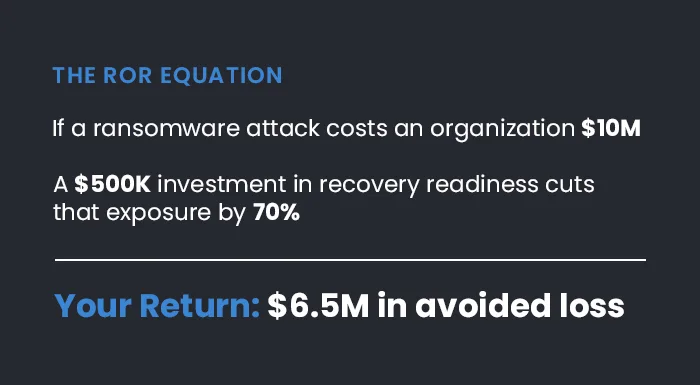
Cybersecurity investment has long been reactive — hard to measure, harder to calcualte ROI. Return on Risk changes that. It treats cyber resilience as an investment with a calculable return: not a cost center, but a risk reduction engine with a dollar figure attached.
The math is straightforward. Recovery gaps are a quantifiable business risk. Every hour of downtime, every failed restore, every unanswered question has a cost. When you invest in data integrity and recovery readiness, you compress those costs. The difference is your Return on Risk.
Imagine your senior security engineer the moment the alarm goes off. Leadership wants answers. The business is down. And without data integrity validation, every question they ask becomes a ball your team has to juggle — until someone drops one.
Which hosts were hit? Which files? When did it start? Without content-level alerting, this is a manual investigation across dozens of systems. Hours pass. The scope is still unclear.
Team says: “We don’t know how many systems are affected.” — Leadership is waiting. The clock is running.
The team finds a backup to restore from. But is it actually clean? Without integrity validation, it’s just a file with a date on it. It could be infected. Restoring from a compromised backup doesn’t fix the problem. It restarts it.
Team says: “We can’t confirm the backup is clean.” — Every hour of debate is another hour of downtime.
Hours become a day. A day becomes two. Revenue stops. SLAs breach. Every team is pulling in a different direction, all of them pulling on the same overloaded engineers. Leadership, legal, security, and finance all want answers nobody can give.
Team says: “We don’t have a timeline we can commit to.” — Trust erodes. Pressure intensifies.
Regulatory notification windows open. Without a continuous audit trail, you can’t demonstrate that controls were in place. The team is still recovering the environment and now generating compliance documentation from scratch.
Team says: “We can’t produce the audit evidence they’re asking for.” — Regulatory exposure on top of operational crisis.
The team commits to a recovery point. Hours into the restore — or after it completes — it becomes clear the backup was infected too. The malware reactivates. You’re back to square one. This is an all-too-common outcome in ransomware recovery.
Team says: “The restore failed. We have to start over.” — Downtime doubles. Costs spike. Confidence collapses.
No single team can juggle all of this at once. When the burden becomes too great, decisions get made under duress, shortcuts get taken, and mistakes multiply — each one adding another ball to the ordeal.
Ransomware recovery follows a predictable path. At each stage, having — or not having — validated data integrity determines whether the team moves forward or gets stuck.
Identify the scope immediately. Which hosts? Which files? What type of attack? CyberSense surfaces this in minutes, not hours.
Understand what the attack did to the data — file by file. Entropy analysis, extension changes, original vs. encrypted versions.
Know your last verified clean backup with confidence. Not a guess based on date — a confirmed, content-validated recovery point.
Run malware signature verification and custom YARA rules against the backup before restoring. Proceed with evidence, not hope.
Confirm the restored environment is clean. Generate a continuous audit trail that satisfies regulators automatically.
Apply new signatures and YARA rules retroactively. Turn every incident into a systemic improvement. The system gets smarter.
The return isn’t theoretical. It compounds across every phase, from the moment you deploy to every recovery event that follows.
Recovery confidence from day one. Data integrity validation activates on existing backups and begins delivering value immediately.
Days — not weeks or months. Knowing your clean recovery point in advance turns chaos into an executable plan. Every hour saved is a direct dollar figure.
A number IT, Security, and Leadership can all agree on. ROR converts vague cyber risk into a concrete business metric: dollars protected, downtime compressed, audit requirements met.
More effective than adding prevention layers alone. One confirmed clean recovery point eliminates the cost of multiple failed restore attempts and extended forensic investigations.
Every scan strengthens the next. New malware signatures and YARA rules apply retroactively across all prior backups. The system gets smarter — and more valuable — with every incident.
Average cost of IT downtime per hour (Gartner)
Complete the form to learn more about implementing the Return on Risk framework in your organization.

