Recover to What? Answering Pressing Healthcare Resilience Questions

Ransomware tabletop exercises in healthcare eventually arrive at the same question: how fast can we recover?
It’s the right question to ask, and most health systems can answer it with reasonable confidence. They have recovery time objectives. They have runbooks. They have protected copies sitting in immutable storage where an attacker can’t reach them.
What far fewer can answer is the question that comes next, usually somewhere around hour six of an actual incident, when the recovery team is staring at three weeks of restore points and trying to decide which one to trust: recover to what?
That question is the subject of a recent IBM piece, “From Recovery to Prevention: Rethinking Healthcare Data Resilience,” and it’s worth reading in full. Its central observation is one we hear echoed in conversations with hospital IT and security leaders, namely that organizations believe they’re prepared right up until the moment they’re tested. Recovery success gets assumed rather than validated. Snapshots turn out to be corrupted. Encryption isn’t consistent across copies. Workflows that looked airtight in a controlled audit behave very differently under the stress of a live incident. IBM calls this the illusion of preparedness, and it’s a fair description of what a lot of healthcare organizations are actually carrying into an attack.
The illusion is durable because the tools most organizations rely on are genuinely good at their job. The problem is they’re answering a narrower question than people assume.
Behavioral detection at the storage layer watches how data is being written. It notices when entropy spikes, when write patterns go strange, when something starts encrypting files at machine speed. That’s enormously valuable, and it’s fast. IBM Storage Defender Sentinel, running on IBM FlashSystem, can flag ransomware behavior within a minute of the first encrypted write, while safeguarded snapshots hold clean copies out of reach.
But detection is an event signal. It tells you that something happened and roughly when. It doesn’t tell you what state your data is actually in — which specific files were touched, which database records were quietly altered, which restore point is genuinely clean versus merely older than the alert. And in an environment where an attacker may have been resident for weeks before triggering encryption, “older than the alert” is not the same thing as safe.
This is the gap that keeps recovery teams scrambling, and it’s why IBM Storage Defender Sentinel doesn’t stop at the storage layer.
Storage Defender Sentinel’s data validation is powered by CyberSense, and brings a deeper analysis to the same problem. Rather than observing how data is written, CyberSense examines the data itself. It runs more than 200 content-based analytics across files, databases, and application data, comparing each snapshot against the last to find the statistical fingerprints of corruption. ESG validated the approach at 99.99% accuracy in detecting ransomware-driven data corruption.

The practical difference matters most following an attack. When a recovery team has to choose a restore point, behavioral detection narrows the field. Content analysis picks the winner, and, just as importantly, produces a forensic report explaining why: which files were corrupted, when the corruption began, and what the attack actually touched.
Together, those two layers turn recovery from a judgment call into a documented decision. One layer stops the bleeding. The other tells you where the wound is.
Healthcare is where the cost of getting this wrong compounds in ways that don’t show up in other downtime calculations.
Consider what a corrupted file looks like in a hospital. An imaging study altered in place still opens. A lab value quietly modified inside an EHR database still displays. A medication record with a changed field renders exactly like a clean one. There’s no visual tell, no error message, nothing that makes a radiologist or a pharmacist pause. The damage surfaces days or weeks later, downstream, in a clinical decision made on data that looked fine.
That’s a materially different risk profile than a retailer restoring a corrupted product catalog. And it sits on top of an environment IBM describes accurately: EHR platforms, imaging systems, Epic deployments, hybrid cloud, all of it running at a scale legacy storage architectures weren’t designed for, all of it subject to HIPAA requirements that don’t just ask whether you recovered, but whether you can demonstrate that data integrity and patient privacy were maintained throughout.
“We restored from backup or a snapshot” is not an answer to that question. “Here is the forensic record of what was corrupted, what wasn’t, and why we selected this recovery point” is.
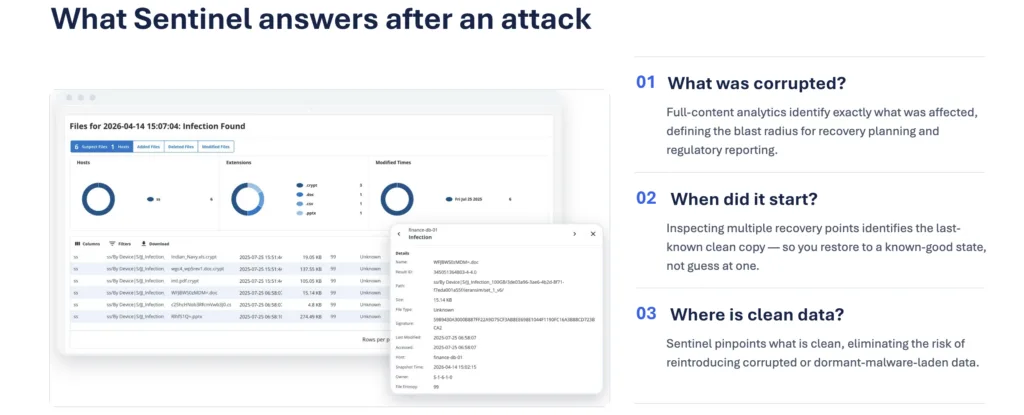
IBM frames the future of resilience around proof, prevention, and trust rather than speed alone. Speed without certainty just means arriving at the wrong recovery point faster.
For healthcare organizations weighing HIPAA exposure, patient safety obligations, and a threat landscape that has singled them out precisely because their data can’t be offline, IBM Storage Defender Sentinel offers fast recovery, yes. But more importantly, it provides the ability to answer, with evidence, what data is clean, validated, and safe to restore from.
***

