How the CyberSense Research Lab Prepares Organizations for Future Attacks

Ransomware is a constantly evolving threat, and organizations need their cybersecurity and recovery solutions to keep pace. Many rely on third-party intelligence sources and YARA rules updates to adapt to new strains. But this is a reactive approach built around extant ransomware. Today’s ransomware evolves faster, making it even harder to catch.
At Index Engines, we’re devoted to staying at the forefront of understanding ransomware, both in its current state and how it will change in the future. The CyberSense Research Lab detonates real ransomware, studies how it corrupts data, and turns emerging behaviors into stronger detection models. Here’s how we study the ways ransomware evolves today, so CyberSense is ready for how it attacks tomorrow.
Ransomware presents such a prevalent threat because it rarely stands still. Attackers continually develop new strains, refine existing malware, and adapt their techniques to evade detection.
With advances in AI and ransomware-as-a-service, sophisticated attack capabilities are accessible to a wider pool of criminals and able to diversify faster than ever. The scale of this evolution is reflected in the FBI’s Internet Crime Report, which identified 63 new ransomware variants during the year, averaging more than five every month.
Going deeper, in our in-house analysis of over 8000 ransomware samples across more than 300 million datasets found that every sample carried a distinct static signature. In addition, nearly 40% of those samples involved directory-entry corruption over the 18% exhibiting full encryption. The result is ransomware that is harder to detect, both at the code level and the damage it leaves behind.
Security solutions that depend heavily on known signatures or previously observed behaviors can struggle to recognize unfamiliar variants. Novel techniques like silent encryption and byteskipping only exacerbate the issue; more on these later. Staying ahead therefore requires more than responding to known threats; it demands continuous research into emerging strains, their behavior and the techniques used to bypass existing defenses.
The findings above are only a surface-level overview of the trends we’re seeing in the CyberSense Research Lab.
In the Lab, our ransomware experts take live samples of today’s most pertinent strains and detonate them in an isolated environment to understand how they affect data—the inner workings of their tactics and techniques—without simulation or inference. Activity is monitored and tracked at both the file and content level to understand behaviors, painting a clearer picture of the effects of ransomware. This, in turn, fuels research: new behaviors are ingested into the Research Lab’s patented AI training process to keep CyberSense and its customers ahead of the newest threats.
Within the past year, the Lab has uncovered a glut of key findings, but of them, six strains stand out as ones of note. Here are some summaries of what we’ve found:
These are just briefs on the techniques recently uncovered by the Lab. You can read more in our Research Lab whitepaper about these findings.
Results like these indicate trends that many ransomware detection solutions are simply unprepared for. But, for the CyberSense Research Lab, the process doesn’t stop there.
Our researchers incorporate learnings from across the 1000+ distinct strains documented daily to develop new ransomware unique to the Research Lab. These novel strains build off these uncovered behaviors to anticipate ways that future attacks may operate.
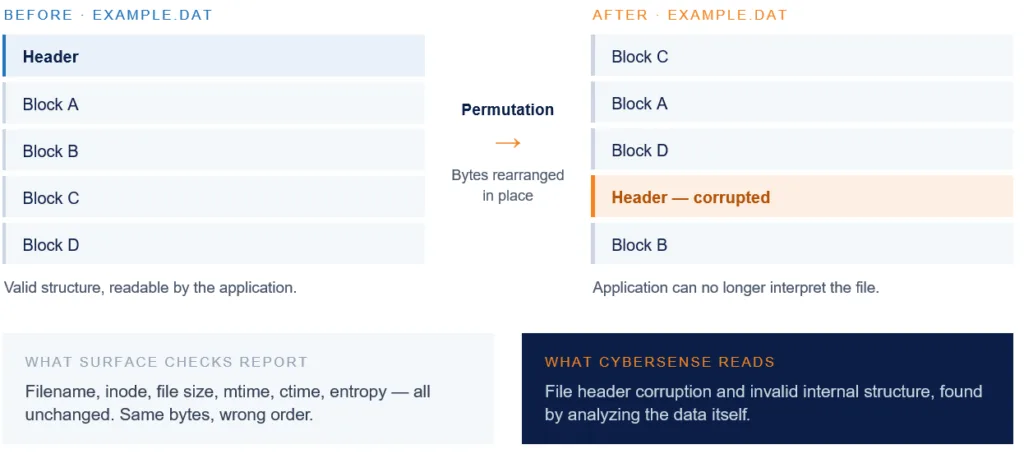
Take the previous Encoder example. Initially, the Encoder sample took a valid data structure and rearranged it with corrupted data in the header. On the surface, this appears as a normal, unchanged file because of the minimal number of bytes affected. But when executed, the file data is destroyed. When detecting on the content level, however, CyberSense identified the affected file’s internal structure, flagging those minute changes as an indicator of compromise.
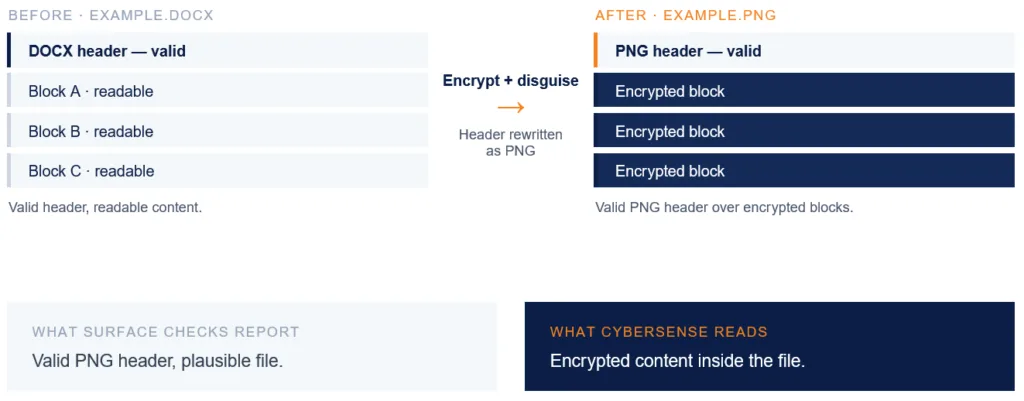
Our researchers built upon that concept to create a new variant leveraging a similar idea: changing the overarching filetype altogether. By packaging everything as a valid PNG file instead of its original DOCX format, the new variant could encrypt the underlying data in a way that slipped past detection methods. This behavior represents a future state of ransomware that could be highly effective at evading common defenses.
As a result, the CyberSense team has built detections anticipating these techniques and other theoretical behaviors. That way, as new ransomware evolves, our customers can rest assured that their storage solution is resilient against emerging attack techniques.
By understanding the behaviors of today’s ransomware, the Research Lab prepares organizations for the attacks of tomorrow. Read here to learn more about our approach and the outcomes it drives.

