From Chaos to Controlled Response: How CyberSense Empowers Rapid Recovery

A recent blog post, “Bolstering Cyber Defenses with AI,” paints a sobering picture of modern cybersecurity challenges. It chronicles how even a well-resourced security operations center, armed with the latest tools and talented analysts, can miss critical threats amid the overwhelming noise of false positives and alert fatigue. The fictional but all-too-realistic scenario describes a team that successfully intercepted two sophisticated attacks, only to miss the third, which ultimately led to data exfiltration and encryption by ransomware actors.
The CISO in that scenario candidly admits the core problem: “When you have that many false positives, stuff is occasionally going to slip through the cracks. The bottom line is we don’t have the manpower to resolve every anomaly report.” His team had done everything right in blocking initial intrusions, but an anomalous SSH connection from an abandoned web server—buried among hundreds of other alerts—went unchecked until it was too late.
This scenario raises a critical question that often goes unaddressed: What happens after the attack succeeds? Even more importantly, how can organizations ensure rapid recovery when ransomware has compromised their systems?
The post highlights how security teams are increasingly overwhelmed across two fronts: technology density and human resourcing, leaving them perpetually reactive rather than proactive. But the other dimension to this challenge that becomes critical once an attack succeeds is understanding which data has been compromised and which remains trustworthy for recovery.
In the scenario described, after gaining domain access to SharePoint and OneDrive, the attackers paused for 48 hours—likely to sell their access to a ransomware gang—before beginning data exfiltration and encryption. During this window and beyond, organizations must know with confidence which backup data to trust for recovery.
This is where CyberSense fundamentally changes the recovery equation.
While the original blog post explores how AI can help security teams manage alert fatigue and improve threat detection, CyberSense addresses what happens when those defenses are breached. Using patented AI and machine learning technology, CyberSense continuously analyzes backup and production data environments to provide definitive answers about data integrity.
The platform’s AI/ML engine doesn’t add to the alert noise that already overwhelms security teams. Instead, it continuously trains on your specific data patterns, learning what normal looks like for your organization. This sophisticated approach enables CyberSense to detect subtle anomalies indicating ransomware infection or data corruption—including threats that may have persisted undetected through multiple backup cycles.
When the blog post’s CISO lamented, “If only we’d had a way to sort through those alerts, separating the wheat from the chaff, and the capability to correlate data from the significant ones, we might have spotted the connection and stopped the third attack,” he was focused on prevention. CyberSense complements those prevention efforts by ensuring that, when attacks do succeed, organizations have clear visibility into the integrity of their data.
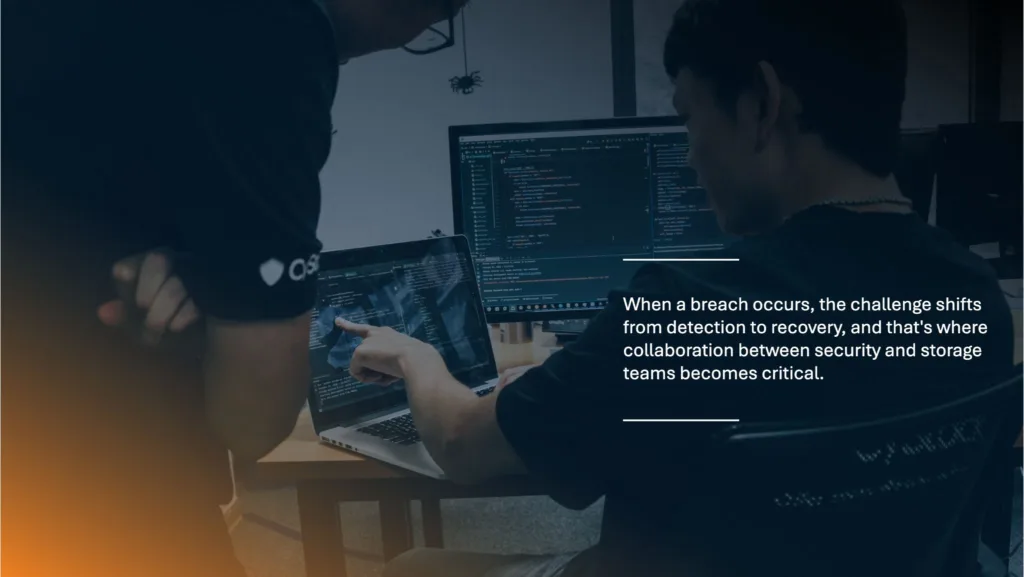
Even properly calibrated SIEM and EDR platforms produce an unmanageable volume of alerts, with the vast majority being false positives, consuming valuable analyst hours. But when a breach occurs, the challenge shifts from detection to recovery, and that’s where collaboration between security and storage teams becomes critical.
CyberSense creates a unified view for both teams. Security teams investigating the breach scope can immediately understand which data assets have been compromised. Simultaneously, storage teams receive clear, actionable intelligence about which backup points are clean and ready for restoration. This eliminates the dangerous guesswork that can lead to restoring already-compromised data, essentially reintroducing the threat into your environment.
The attackers in the post’s scenario moved swiftly once they returned with domain access, beginning immediate data exfiltration and encryption. In ransomware attacks, every minute counts. Organizations need to restore operations quickly to minimize downtime, data loss, and financial impact.
CyberSense dramatically accelerates recovery by eliminating the time-consuming process of manually validating backup integrity. Its AI-driven analysis provides immediate confidence in which data sets are clean, enabling storage teams to initiate restoration without delay. When ransomware actors are actively encrypting data, this speed advantage can mean the difference between hours of downtime and days or weeks of recovery efforts.
Enterprises face growing threats of AI-powered cyberattacks, with GenAI tools being used to write malware, generate phishing emails, and set up scam websites. As attacks grow more sophisticated, defense systems must evolve just as quickly.
CyberSense’s patented machine learning technology provides exactly this adaptive defense, specifically focused on protecting what matters most when prevention fails: your data. The platform continuously learns and adapts to identify increasingly sophisticated ransomware variants, ensuring that your last line of defense remains secure.
The challenges outlined in “Bolstering Cyber Defenses with AI” are real and growing. Modern security teams face an impossible volume of alerts, increasingly complex IT environments, and attackers leveraging AI to scale their operations. But even the best prevention strategies will occasionally fail, as the blog post’s scenario illustrates.
CyberSense provides what organizations desperately need in these moments: confidence in their data integrity and the ability to recover quickly. By empowering both security and storage teams with clear intelligence about which data can be trusted, CyberSense transforms recovery from a time-consuming, uncertain process into a rapid, confident response.
When alert fatigue overwhelms your security team and sophisticated attacks slip through even the best defenses, CyberSense ensures you can answer the most pressing question: What data is clean, and how quickly can we recover?

